
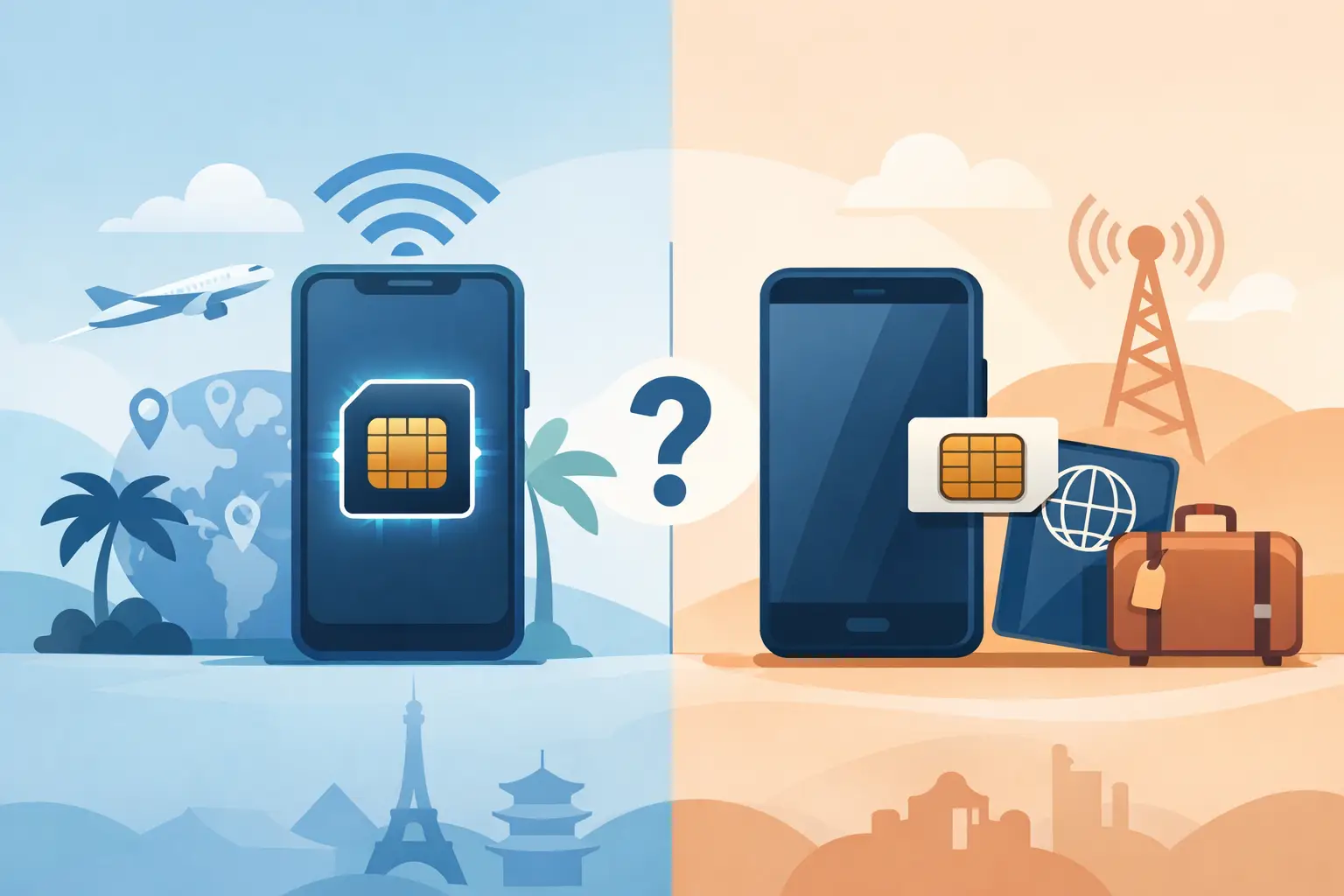
Arriving in Tokyo, Rome, or São Paulo with a full itinerary and no working data is an avoidable disruption. The choice between travel eSIM versus roaming plans affects more than the first map search after landing: it shapes how easily you can confirm a transfer, access hotel details, manage reservations, and stay connected without unexpected charges.
For travelers who prize efficiency, the better option is rarely a universal answer. A travel eSIM can offer excellent value and control, while carrier roaming can be the most convenient choice for a short, high-stakes trip. The right decision comes down to your destination, device, data needs, and tolerance for a little pre-departure setup.
Travel eSIM versus roaming plans at a glance
A travel eSIM is a digital SIM plan purchased for use away from home. Instead of inserting a physical card, you install the plan on an eSIM-compatible, unlocked phone, usually by scanning a QR code or following in-app instructions. Many options are country-specific, while regional and global plans can cover multiple destinations under one package.
Roaming uses your existing mobile carrier and regular phone number abroad. Your phone connects to a partner network in the country you are visiting, and usage is billed through your home carrier. Depending on your plan, that may mean a daily international pass, a monthly add-on, or pay-as-you-go charges.
The difference is primarily one of control. With an eSIM, you generally select a fixed data allowance and duration before you travel. With roaming, you keep your familiar carrier relationship and number, but pricing and usage rules can be less favorable if you exceed the plan’s included limits.
When a travel eSIM is the better choice
A travel eSIM often suits travelers visiting one country for several days or moving through regions where a single regional plan is available. It is particularly appealing when mobile data is the priority: navigation, messaging apps, ride-hailing, restaurant reservations, digital tickets, and sharing plans with travel companions.
The cost structure is usually easier to manage. You can choose a plan with a defined data amount, such as 5 GB or 20 GB, for a defined period. That makes it easier to set a connectivity budget before departure rather than wondering how much a day of maps, photos, and video calls will add to your phone bill.
An eSIM can also give you more choice over coverage. International roaming connects you to whichever partner networks your carrier supports. A travel eSIM provider may offer access to several local networks, although the exact arrangement varies by destination and plan. Before buying, review the plan’s supported countries, network information, validity period, and whether it permits hotspot use.
For a longer stay, an eSIM is often the more refined practical option. It lets you separate travel data from your home line, retain your primary number for essential calls or texts, and avoid using expensive roaming data for every routine task. On phones with dual-SIM capability, you can keep your home line active for calls and verification codes while assigning cellular data to the travel eSIM.
There are trade-offs. Most travel eSIMs are data-only, meaning they do not include a local phone number for conventional calls and SMS. That is rarely a problem for travelers using FaceTime, WhatsApp, iMessage, or similar services, but it may matter when a destination requires a local number for a service or a reservation. Activation can also require a few minutes of attention before departure or while connected to airport Wi-Fi.
When roaming is worth the premium
Roaming plans are hard to beat for simplicity. If your carrier offers a reasonably priced international day pass and you are traveling for a weekend, a short business trip, or an important event, keeping your existing setup may be worth the higher daily cost. Your phone number works as expected, and there is no need to install, label, or switch between mobile plans.
This can be especially valuable for travelers who rely on receiving calls, SMS verification codes, or communications from clients and colleagues. It is also a sensible fallback if your phone is carrier-locked, does not support eSIM technology, or you simply prefer to minimize technical steps before an already demanding departure.
The most common drawback is price volatility. Some roaming passes charge a fixed daily fee whenever you use your phone abroad, even if you only check a map once. Others include a high-speed data allowance that slows substantially after a threshold. Pay-as-you-go roaming, meanwhile, can be expensive enough to turn an ordinary day of data use into an unwelcome post-trip surprise.
Coverage deserves attention as well. A plan marketed as international may work well in major cities but have different network access in smaller towns, islands, or rural areas. This is true for both roaming and eSIMs. For a trip built around remote lodges, driving routes, or outdoor experiences, check coverage expectations for the precise areas on your itinerary rather than relying on a country-level promise.
Compare the details that change the experience
Price is only one factor. A less expensive plan that expires before your final transfer, throttles speeds after a small allowance, or lacks service at a connecting destination is not necessarily the better value.
Start with the length and shape of the trip. A three-day stay in one city may favor a carrier day pass because of its convenience. A two-week European itinerary, a multi-city Asian journey, or a month working remotely abroad often favors a regional or country-specific eSIM with a larger data allowance.
Then consider the type of connectivity you actually need. Light users who only need maps, messaging, and occasional browsing can often choose a modest data plan. Travelers who upload videos, use cloud-based work files, take frequent video calls, or tether a laptop should look carefully at data limits, high-speed thresholds, and hotspot terms. Hotel Wi-Fi may reduce your need for mobile data, but it should not be your only plan for airport arrivals, transit, and time outside the property.
Phone compatibility is non-negotiable. Confirm that your device supports eSIM and is unlocked before purchasing a travel eSIM. It is wise to install it before departure, but do not activate a plan too early if its validity starts at installation rather than first connection in your destination. Keep the QR code or activation details available offline in case you need to reinstall the plan.
Finally, review how you will handle your primary number. With a dual-SIM setup, turn off data roaming on your home line and designate the eSIM as the line for cellular data. You may still receive calls and texts on your usual number, depending on carrier settings, but these can trigger roaming charges. If a message can be sent through an internet-based app instead, that is often the more economical choice.
A premium travel setup is usually a layered one
For many international trips, the strongest approach is not choosing one method exclusively. Use a travel eSIM as your main source of data and keep your home carrier line available for essential texts, banking alerts, and calls. This arrangement provides cost control without cutting off access to the number tied to your personal and professional life.
Before departure, save boarding passes, hotel confirmations, transfer details, and key addresses to your phone. Download offline maps for your arrival city, and confirm that your travel eSIM is installed but configured according to its activation rules. If you choose roaming, understand whether the pass activates automatically and whether a single text message or brief data session starts a full day of charges.
The same thoughtfulness applied to flights, hotels, transfers, and experiences should extend to connectivity. The Marquis Global Escapes brings these planning categories into one considered search experience because the smoothest journeys are built from details that work together.
A travel eSIM offers exceptional value when data flexibility and longer itineraries are the priority. Roaming earns its place when speed, familiarity, and your existing phone number matter most. Choose the option that lets you step off the plane focused on the journey ahead, not on finding a signal or decoding your next bill.