
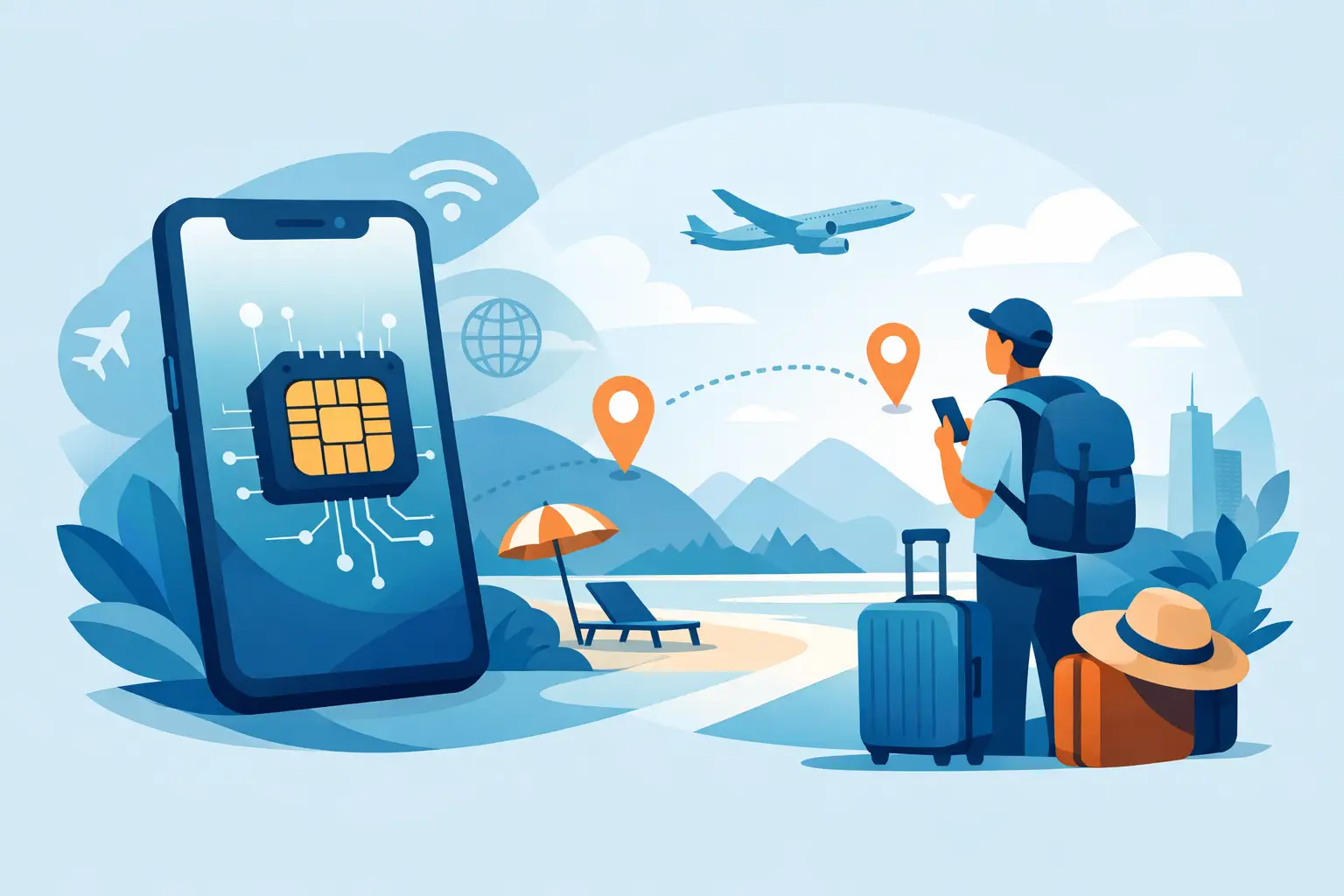
A delayed transfer, a last-minute restaurant change, a driver waiting outside the wrong terminal – these are small disruptions until your phone has no usable data. A travel eSIM gives your device a local or regional mobile data connection without the inconvenience of finding a physical SIM card after landing. For travelers who expect every detail of a trip to move with purpose, it is one of the most practical arrangements to make before departure.
Whether you are coordinating a hotel arrival in Tokyo, confirming a private tour in Florence, or keeping an eye on a connecting flight through Dubai, reliable mobile data is no longer a minor convenience. It supports the decisions that keep a well-planned itinerary feeling composed.
What Is a Travel eSIM?
An eSIM is a digital SIM embedded in many newer smartphones, tablets, and smartwatches. Instead of inserting a small plastic card, you add a mobile plan to your device electronically, usually by scanning a QR code or following in-app instructions. A travel eSIM is designed for use away from home, with plans that may cover one country, a region, or a broad range of global destinations.
The appeal is straightforward. You can compare plans, purchase one before travel, and often install it while you still have dependable Wi-Fi at home or in your hotel. Once the plan is activated, your phone can use that eSIM for mobile data while your primary line remains available for calls, texts, and verification messages.
That said, an eSIM is not automatically the right answer for every trip. It depends on your device, your destination, how much data you use, and whether you need a local phone number rather than data alone. Most travel-focused eSIM plans are data-only, which works well for maps, messaging apps, ride services, reservations, and internet calling. Travelers who need conventional local calling or extensive voice service should confirm what a plan includes before purchasing.
Why Travel eSIMs Suit Premium Itineraries
A thoughtfully planned trip has many moving parts: flights, hotels, airport transfers, dining reservations, car rentals, and experiences that may shift with weather or timing. Connectivity brings those details together in real time. It lets you message a host from the arrivals hall, share your location with a driver, access a digital hotel confirmation, or make an informed change without searching for public Wi-Fi.
The strongest advantage is control. International roaming from a US carrier can be simple, but it can also be costly or limited depending on the destination and plan. Public Wi-Fi may be available in airports and hotels, yet it is not always dependable when you are in transit or navigating a new neighborhood. A travel eSIM creates a more consistent middle ground: data access chosen around your itinerary, installed on your terms.
For multi-country travel, a regional plan can be especially useful. A traveler moving from France to Switzerland and Italy, for example, may prefer one regional eSIM over purchasing separate plans at each border. This reduces administrative friction and helps preserve continuity when the itinerary is full. Still, regional coverage should never be assumed. Check the exact destination list, including transit countries and island destinations, before committing.
Choose a Plan Around Your Actual Travel Style
The lowest-priced plan is not necessarily the best value. A light-data package may be sufficient for a long weekend spent mostly in a resort, while a road trip, family vacation, or work-intensive journey can require substantially more data. Maps, short-form video, cloud photo backups, video calls, and hotspot use can consume an allowance faster than expected.
Start by considering how you will use your phone once you arrive. If you mainly need directions, messages, reservations, and occasional browsing, a modest data plan may be appropriate. If you intend to work remotely, use your phone as a hotspot, stream entertainment during long transfers, or coordinate a group across multiple locations, look for a larger allowance or an unlimited plan with clearly stated high-speed terms.
“Unlimited” deserves a closer look. Some plans offer unlimited data but reduce speeds after a daily threshold. Others limit hotspot access, restrict access to certain networks, or apply fair-use policies that affect heavy users. These plans can still be excellent choices, but only when the conditions match your needs. Read the coverage and speed details with the same care you would apply when comparing a flight itinerary or hotel room category.
Plan duration matters as well. A 7-day plan can look attractive until a late departure, early arrival, or extended stopover adds another day. Selecting a plan with a small timing cushion is often worth more than spending part of a trip trying to add data from an unfamiliar airport connection.
Confirm Compatibility Before You Buy
Before choosing a travel eSIM, confirm that your phone supports eSIM technology and is carrier-unlocked. Many recent premium smartphones do, but availability can vary by model, region, and carrier. A device that is still locked to a mobile provider may not accept a plan from another network.
It is also wise to check how many eSIM profiles your device can store and how many can be active at once. Many phones allow you to retain several installed eSIMs but use only one or two at a time. For most travelers, this is enough to keep a US line active for calls and security codes while assigning mobile data to the travel plan.
A few settings make a meaningful difference. Turn off data roaming for your home line if you want to avoid accidental roaming charges. Set the travel eSIM as the preferred source for cellular data. Consider disabling automatic app updates and photo backups over cellular data, particularly on smaller plans. These steps take minutes before departure and prevent unwelcome surprises later.
Install Before Departure, Activate With Care
Installation and activation are not always the same event. In many cases, you can install an eSIM profile before leaving the US, then activate it only when you arrive or when the plan connects to a supported destination network. Other plans begin their validity period the moment they are installed. The distinction is essential.
Read the provider’s activation terms before scanning the QR code. If your trip begins next week and the plan starts immediately upon installation, waiting is the wiser choice. If installation can be completed in advance without starting the clock, do it while you have stable Wi-Fi and time to troubleshoot.
Save the QR code and setup instructions somewhere accessible offline, such as a downloaded file or a secure note on another device. Then, after landing, give the phone a few minutes to register on a local network. If it does not connect, check that the eSIM line is turned on, cellular data is assigned correctly, and data roaming is enabled for the travel eSIM when required by the provider.
Coverage Is More Than a Country Name
A plan that lists a destination may still perform differently across cities, islands, mountain regions, and rural routes. Coverage is shaped by the local carrier partner, terrain, network congestion, and the phone bands supported by your device. For an urban itinerary centered on major hotels, restaurants, museums, and business districts, service is generally easier to find than it is on a remote coastal drive or backcountry excursion.
This is where a little itinerary awareness pays off. If reliable data is essential for a self-drive route, a private villa stay, or a work-sensitive trip, favor plans that identify their network partners and provide clear support options. Download offline maps, hotel confirmations, transfer details, and key addresses as a sensible backup. Premium travel is not about assuming nothing will change. It is about having the right options when it does.
A Better Connection, Chosen in Advance
A travel eSIM works best when it is treated as part of the trip’s essential logistics, not as an afterthought at the gate. Compare coverage where you will actually travel, select data that reflects your habits, and set up your device before the itinerary begins.
The Marquis Global Escapes brings flights, stays, transportation, experiences, and travel eSIM options into one considered planning environment. When your connectivity is organized alongside the rest of the journey, you can spend less time solving small problems and more time being present for the places you chose to see.